What Language Is This? How to Identify Any Language From Text
A message in an unknown language, a label on a product, a comment on your website: before you can translate it, you need to know what it is. Here's how to identify a language instantly, and some clues you can spot yourself.
Quick answer
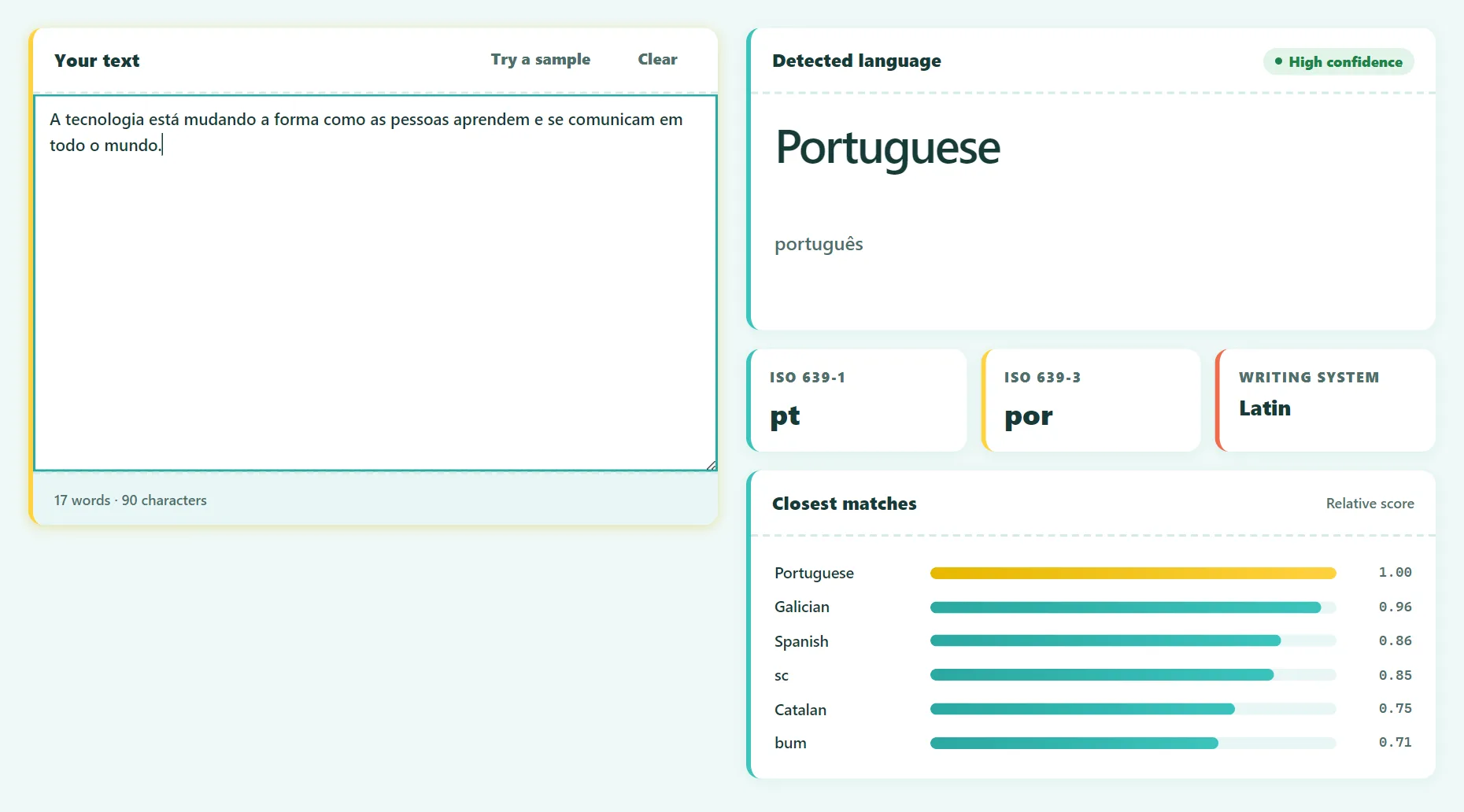
Paste the text into a language detector. It compares the text's letter patterns with profiles of 180+ languages and shows the most likely match, its ISO code and close alternatives. Use at least one full sentence for a reliable result.
How to identify a language in seconds
- Open the free Language Detector.
- Paste or type the text. A sentence of 20 characters or more usually works.
- Read the detected language, its ISO 639 codes and its writing system.
- Check the alternatives list when two related languages score close together.
Once you know the language, paste the text into a translator with that language selected. Translation is usually more accurate than relying on the translator's auto-detect.
Try it free: Language Detector
Identify the language of any text among 180+ languages. Runs in your browser, no sign-up.
Clue 1: the writing system
The alphabet alone often narrows it down to a few languages:
| Script | Looks like | Common languages |
|---|---|---|
| Latin | Hello | English, Spanish, French, German, Turkish, Vietnamese, Indonesian… |
| Cyrillic | Привет | Russian, Ukrainian, Bulgarian, Serbian, Kazakh |
| Arabic | مرحبا | Arabic, Persian, Urdu, Pashto |
| Devanagari | नमस्ते | Hindi, Marathi, Nepali |
| Han (Chinese characters) | 你好 | Chinese; also used in Japanese |
| Hiragana / Katakana | こんにちは | Japanese |
| Hangul | 안녕하세요 | Korean |
| Greek | Γεια σου | Greek |
| Hebrew | שלום | Hebrew, Yiddish |
| Thai | สวัสดี | Thai |
A useful tip: if text with Chinese characters also contains rounded characters like の or は, it's Japanese.
Clue 2: special letters and accents
Within the Latin alphabet, a few characters are strong giveaways:
- ñ and ¿ ¡: Spanish
- ã õ and ç: Portuguese (ç also appears in French and Catalan)
- ß and frequent ä ö ü: German
- å with ø or æ: Danish or Norwegian; å ä ö: Swedish
- ł ż ś ć: Polish
- ğ ş ı (dotless i): Turkish
- ő ű: Hungarian
- ơ ư and stacked accents like ệ: Vietnamese
Clue 3: common short words
Small function words appear in almost every sentence: "the" and "and" in English, "el", "la" and "que" in Spanish, "le", "la" and "et" in French, "der", "die" and "und" in German, "het" and "een" in Dutch, "il" and "che" in Italian.
How automatic language detection works
Every language has a statistical fingerprint made of short letter sequences. Detectors break text into trigrams (overlapping groups of three characters) and count them. English text is full of "the", "ing" and "and", while Spanish favors "que", "ció" and "los".
Our tool uses the open-source franc library, which first checks the script, then compares the trigram counts with the profiles of more than 180 languages. The closest profile wins, and the next-best matches are shown as alternatives.
Why detection sometimes gets it wrong
- Very short text. "No" is valid in dozens of languages. Use at least one full sentence.
- Closely related languages. Spanish and Portuguese, Czech and Slovak, Serbian, Croatian and Bosnian, Malay and Indonesian share much of their vocabulary.
- Mixed text. A message with half English and half Hindi returns the dominant language. Test each part separately.
- Names, URLs and numbers add noise without giving clues about the language.
- Romanized text. Hindi or Arabic written in Latin letters is much harder to identify.
ISO language codes explained
Developers and translators refer to languages by standard codes:
- ISO 639-1: two letters, such as
en,es,fr,de,zh. - ISO 639-3: three letters covering thousands of languages, such as
eng,spa,fra.
In HTML, the lang attribute uses these codes (<html lang="en">). It helps screen readers pronounce text correctly and helps search engines understand your page.
Frequently asked questions
How many languages can be detected?
Our detector covers more than 180 languages and writing systems.
Can it identify a language from a photo?
First extract the text with an image-to-text (OCR) tool, then paste the result into the detector.
Can it identify spoken language?
No, this tool works on written text. For audio, transcribe it first with a speech-to-text app set to the right language.
Is my text sent anywhere?
No. Detection runs entirely in your browser.
The bottom line
The script and a few special letters often tell you the language family at a glance. For a precise answer, paste a full sentence into a language detector, check the alternatives for closely related languages, then translate with the right language selected.
Found something out of date or unclear? Email contact@ultratoolsai.com and we'll fix it.