What Is Keyword Density, and Does It Still Matter for SEO?
Keyword density used to be an SEO obsession. Today, Google is far better at understanding topics than counting words. Here's what keyword density really tells you, and how to use keywords the way search engines expect.
Quick answer
Keyword density is the percentage of words in a text that are a given keyword: (keyword count ÷ total words) × 100. There's no ideal density for ranking, and Google warns against keyword stuffing. Use density as a sanity check: make sure your main topic is clearly present, and that no phrase is repeated so often it reads unnaturally.
How to calculate keyword density
The formula is simple:
Keyword density = (number of times the keyword appears ÷ total number of words) × 100For example, if "running shoes" appears 8 times in a 1,000-word article, its density is 0.8%. For multi-word phrases, some tools count each occurrence of the phrase, while others multiply by the number of words in the phrase. Just be consistent when comparing pages.
Does keyword density matter for Google?
Not as a ranking formula. Google's spam policies specifically name keyword stuffing, which means repeating words unnaturally to manipulate rankings, as a practice that can hurt a site. Google representatives have said for years that there's no ideal keyword density to aim for.
Modern search engines understand topics and meaning, not just exact words. They recognize synonyms, related terms and the intent behind a search. A page about "running shoes" that also discusses cushioning, pronation, trail running and sizing shows real topical depth.
So why measure density at all? Because it's still a useful diagnostic:
- If your main keyword appears zero or one time in a long article, your topic may be unclear to readers and search engines.
- If a phrase makes up several percent of your text, it probably reads as repetitive to humans.
- Comparing your page with top-ranking pages shows which subtopics they cover that you don't.
As a rule of thumb, main keywords in naturally written content often fall somewhere around 0.5–2.5%. That's a range that usually reads well, not a target that ranks.
How to check keyword density for free
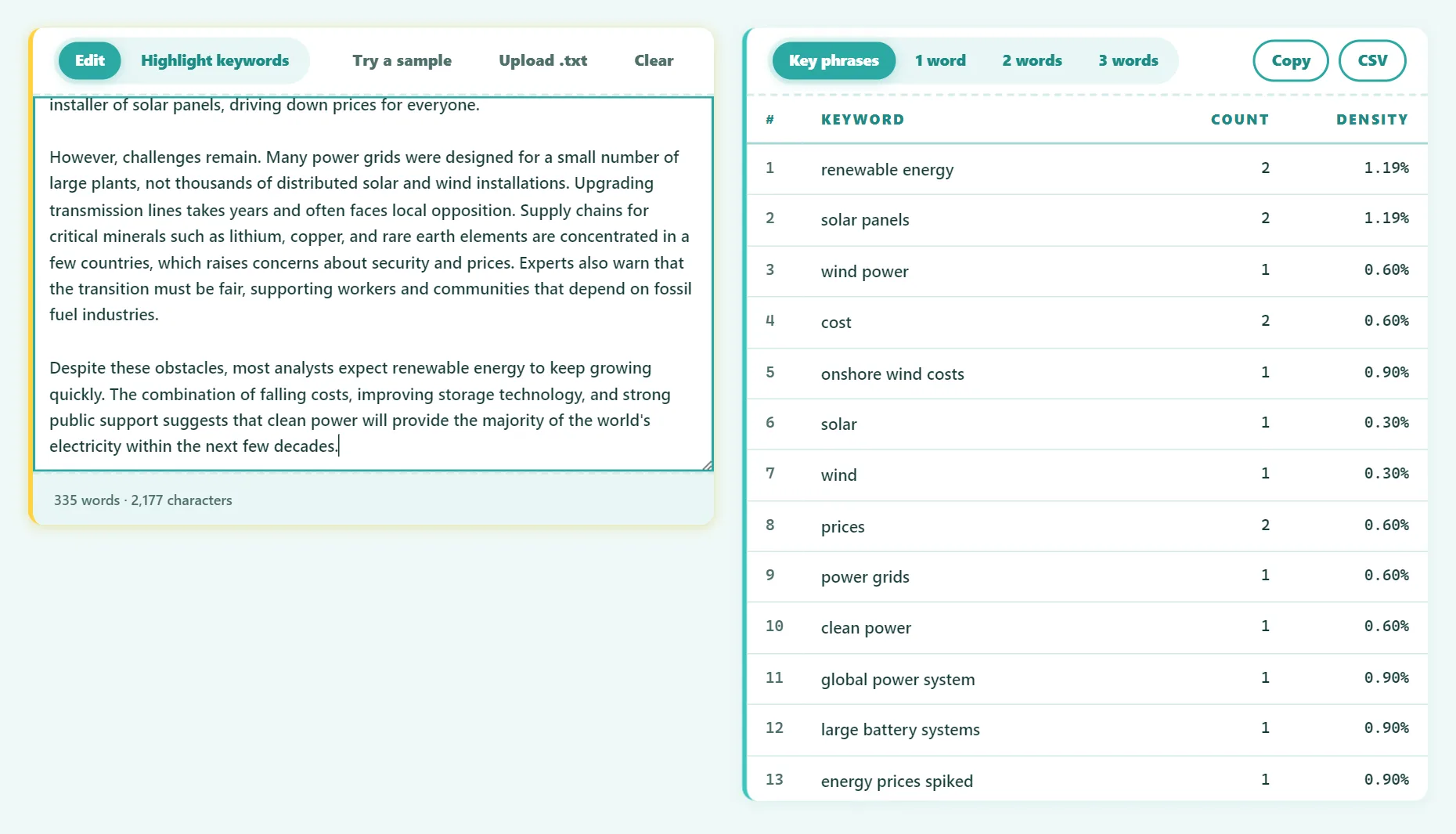
- Open the free Keyword Extractor.
- Paste your article, or upload a .txt file. Paste only the main content, not menus and footers.
- Switch between key phrases, single words, and two- or three-word phrases.
- Check each term's count and density, and use highlighting to see where it appears.
- Export the list to CSV to compare drafts or competitor pages.
Try it free: Keyword Extractor
Find the most important keywords and phrases for SEO. Runs in your browser, no sign-up.
Where to place keywords (naturally)
Placement matters more than repetition. Include your main topic where both readers and search engines look first:
- Title tag and H1: describe exactly what the page is about.
- The first paragraph: confirm the reader is in the right place.
- A few subheadings, where they genuinely describe the section.
- The URL: short and descriptive, like
/blog/what-is-keyword-density/. - Image alt text, only when it accurately describes the image.
- The meta description: not a ranking factor, but it can appear in search results and affect clicks.
Signs of keyword stuffing
Example of stuffing: "Our cheap running shoes are the best cheap running shoes. Buy cheap running shoes online, because cheap running shoes from our cheap running shoes store…"
- The same phrase in almost every sentence.
- Awkward grammar to fit an exact phrase ("best pizza New York near").
- Lists of keywords or city names with no real content.
- Hidden text, or text in the same color as the background.
If you read your text aloud and it sounds robotic, rewrite it.
What to focus on instead
- Search intent. Does the searcher want a definition, a how-to, a comparison or a product? Match the format.
- Topical coverage. Answer the follow-up questions people naturally have. Look at "People also ask" for ideas.
- Related terms. Use synonyms and related vocabulary naturally. They help search engines understand your topic.
- Readability. Clear, well-structured writing keeps visitors on the page. Check it with a readability checker.
- Original value. Experience, examples, data or tools that other pages don't offer.
Frequently asked questions
What is a good keyword density?
There's no ideal figure for ranking. As a readability check, main keywords around 0.5–2.5% usually read naturally. Write for readers first.
What are long-tail keywords?
Longer, more specific phrases such as "best trail running shoes for wide feet". They have less search volume but clearer intent, and they're often easier to rank for.
Should I use the exact keyword or variations?
Both. Use the main phrase where it fits naturally, and use variations and synonyms elsewhere. Search engines understand that they mean the same thing.
Is my text sent anywhere?
No. The Keyword Extractor runs entirely in your browser.
The bottom line
Keyword density isn't a ranking lever, but it's a useful sanity check. Make your topic clear in the title, intro and headings, cover the subject thoroughly, and if any phrase starts to feel repetitive, rewrite it.
Found something out of date or unclear? Email contact@ultratoolsai.com and we'll fix it.